
Critical Vulnerability in Linux KVM: Host Server Compromise via Virtual Machine!
A new critical vulnerability, registered under identifier CVE-2026-53359 and dubbed “Januscape,” has been discovered in the cybersecurity landscape. This vulnerability exists in the memory management mechanism of the Linux Kernel-based Virtual Machine (KVM) virtualization system and could allow a malicious virtual machine (Guest) to corrupt the host operating system’s kernel memory and gain control over it.
The most notable aspect is that this vulnerability has existed in the Linux kernel code for nearly 16 years without being discovered. Security researchers note that the vulnerability affects KVM environments based on Intel and AMD processors and could break one of the most fundamental principles of virtualization — the isolation between host and guest systems.
What Is Linux KVM?
Kernel-based Virtual Machine (KVM) is a virtualization technology built into the Linux kernel that allows multiple independent virtual machines to run on a single physical server.
Today, KVM is widely used in many data centers, cloud infrastructures, and corporate servers. Specifically:
- managing virtual servers;
- organizing cloud services;
- creating test and development environments;
- managing containers and virtual machines —
KVM is one of the primary virtualization platforms. Therefore, any critical vulnerability in KVM can directly affect the security of thousands of servers and millions of virtual machines.
What Is the Cause of the Vulnerability?
According to experts, the issue arises in the memory management mechanism called the Shadow Memory Management Unit (Shadow MMU) within KVM.
Typically, modern Intel and AMD processors use hardware-based virtual memory management technologies (Intel EPT and AMD NPT). However, when Nested Virtualization is used — that is, when another virtual machine is launched inside a virtual machine — KVM in some cases falls back to the Shadow Paging mechanism.
It is in this rarely used code path that a logical error exists, which can have serious security implications.
How Does the Vulnerability Work?
KVM uses special memory pages called Shadow Pages to manage virtual memory.
According to the analysis, when reusing an existing Shadow Page, KVM in some cases only checks the Guest Frame Number (GFN) value. However, the Role of this page is not verified.
As a result, Shadow Pages with different roles can be mixed up.
This leads to incorrect operation of the Reverse Mapping (rmap) mechanism within KVM. This mechanism tracks how virtual memory maps to the host’s physical memory.
Over time, this inconsistency leads to a Use-After-Free type error. In such a situation, the system accesses a previously freed memory region.
If this memory has been allocated for another object, KVM writes data to the wrong location, resulting in host kernel memory corruption.
What Are the Consequences of an Attack?
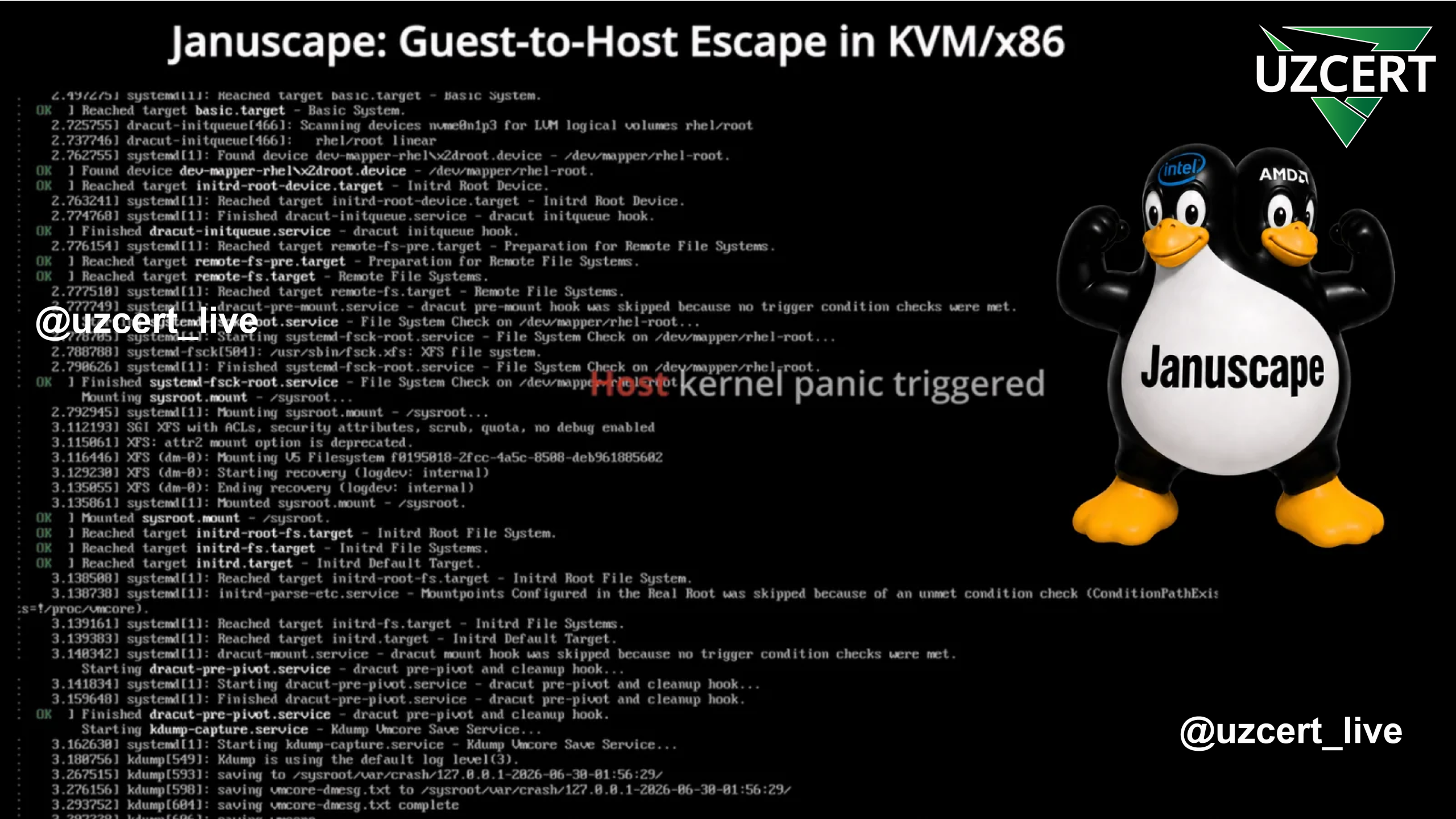
Proof-of-Concept (PoC) tests published by security researchers have shown that this vulnerability can be used to successfully carry out a Denial-of-Service (DoS) attack on the host system.
During the test, specially crafted memory operations were performed inside the virtual machine, causing KVM’s integrity check mechanism to detect memory corruption.
After that, the Linux kernel entered a Kernel Panic state, and the entire host server ceased operation.
If the CONFIG_BUG_ON_DATA_CORRUPTION protection mechanism is enabled in the system, the server fails almost immediately.
However, experts are concerned about more than just this — the vulnerability is not limited to DoS attacks.
Researchers have confirmed that this flaw can also be used for Guest-to-Host Escape — that is, executing arbitrary code with Root privileges in the host operating system.
This gives the virtual machine user the ability to establish control over the entire server.
The Threat to Cloud Infrastructures
This vulnerability poses a particular danger to cloud service providers.
In many cloud platforms, virtual machines from multiple clients run on the same physical server. If one of them exploits this vulnerability, it could theoretically damage the host system or affect other clients’ resources.
Therefore, the risk level is especially high in environments with Nested Virtualization enabled.
Affects Both Intel and AMD Systems Equally
Another important feature of the Januscape vulnerability is that it is not tied to a single processor manufacturer.
Because the vulnerable code resides in KVM’s general x86 virtualization component, it can be exploited in almost the same way on:
- Intel VMX;
- AMD SVM
platforms. The PoC developed by researchers has been shown to work successfully on both architectures.
The Vulnerability Has Been Exploited in Practice
According to experts, the Januscape vulnerability was exploited as a Zero-Day prior to its public disclosure through the Google kvmCTF program.
This indicates that the vulnerability is not only theoretical but also a practical threat.
Following a responsible disclosure process, Linux kernel developers developed a fix in a short time and integrated it into the official kernel code.
How Was the Issue Resolved?
In the new update, the Shadow Page reuse mechanism has been redesigned.
Now, before reusing an existing Shadow Page, KVM checks not only the Guest Frame Number (GFN) but also its Role value.
As a result, confusion between Shadow Pages with different roles is prevented, and the root cause of the vulnerability is eliminated.
Who Is at Risk?
The risk level is considered high in the following environments:
- Linux servers using KVM-based virtualization;
- systems with Nested Virtualization enabled;
- cloud service provider infrastructures;
- multi-user virtualization platforms;
- environments where untrusted users are allowed to create virtual machines.
Protection Recommendations
To protect against this vulnerability, it is recommended to take the following measures:
- immediately install the latest Linux kernel security updates that address this vulnerability;
- disable Nested Virtualization if it is not strictly necessary;
- regularly conduct security audits of servers running KVM;
- monitor for unusual memory operations in virtual machines;
- enable kernel hardening mechanisms on host systems;
- continuously monitor security bulletins released by Linux distribution developers.
Conclusion
CVE-2026-53359 (Januscape) is assessed as one of the most dangerous vulnerabilities discovered in the KVM virtualization system in recent years. This bug, which remained hidden for nearly 16 years, could break the principle of reliable isolation between virtual machines and the host system.
Using this vulnerability, a malicious virtual machine can corrupt host kernel memory, cause server failure, and under certain conditions execute arbitrary code with Root privileges in the host operating system.
Therefore, all organizations and system administrators using KVM-based virtualization are strongly advised to immediately install the latest Linux kernel security updates, reconsider the use of Nested Virtualization, and ensure regular monitoring and security auditing of virtualization environments.