Attackers Can Gain Unauthorized Access to Your Telegram Account! Critical Vulnerability Discovered in fast-mcp-telegram Package. Users Urged to Immediately Install Security Update.
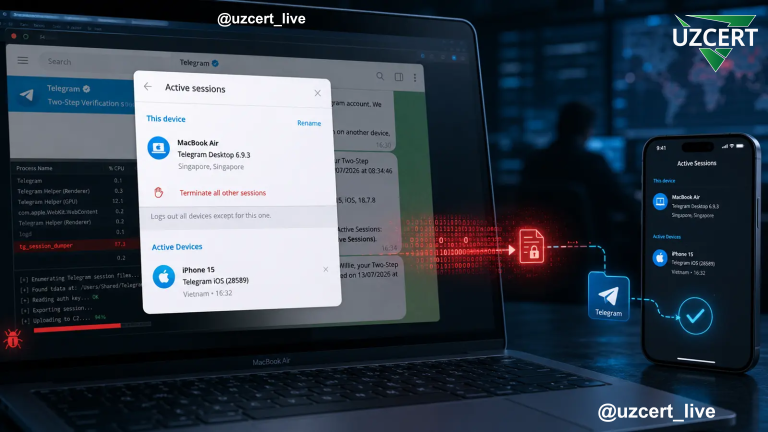
A new critical vulnerability, registered under identifier CVE-2026-52830, has been discovered in the cybersecurity landscape. This vulnerability exists in the fast-mcp-telegram package and could allow attackers to gain remote unauthorized access to servers using this package, hijack Telegram sessions, and perform various actions on behalf of the user.
According to experts, the vulnerability is present in all versions up to and including 0.19.0 and has been fixed in version 0.19.1. Therefore, all users and organizations using this package are strongly advised to update their software as soon as possible.
What Is fast-mcp-telegram?
fast-mcp-telegram is a Model Context Protocol (MCP) server designed to work with the Telegram messenger. It allows artificial intelligence agents and automated systems to interact with a Telegram account.
Using this package, the following actions can be performed:
- reading Telegram messages;
- sending messages to users;
- downloading or sending media files;
- performing various operations through the Telegram API;
- integrating the Telegram account with other automated services.
Therefore, any security issue in this package can directly affect the security of not only the Telegram account but also the automated systems and services connected to it.
What Is the Nature of the Vulnerability?
The issue is related to the improper handling of Bearer Token values transmitted via HTTP.
Bearer Token is typically used for user authentication, i.e., to verify the user’s right to use the system. However, in the fast-mcp-telegram package, this token is used not only as an authentication mechanism but also to determine the path to the Telegram session file.
The main problem is that the program does not sufficiently validate the content of the token submitted by the user. Even if the token contains special characters that allow directory traversal (such as ../, .., /, and others), they are not filtered.
As a result, an attacker, by sending a specially crafted token, can access other directories on the server and reach the standard Telegram session file.
How Does a Path Traversal Attack Work?
The discovered vulnerability falls under the Path Traversal (Directory Traversal) type.
In this type of attack, the attacker uses special characters to attempt to escape the allowed directory and access other files on the server.
In this case, the developers attempted to block the use of the standard session named “telegram”. That is, if a user attempts to directly use a token with the name telegram, the system rejects it.
However, an attacker can send a token like the following:
../fast-mcp-telegram/telegram
Since such a token is not properly validated, the system resolves it to an actual file path and thus still accesses the blocked session file.
Thus, the authentication mechanism is effectively bypassed.
What Happens If the Attack Is Successful?
If a standard Telegram session exists on the server (typically stored at:
~/.config/fast-mcp-telegram/telegram.session),
the attacker can use this session without having any real authentication credentials.
As a result, they gain the following capabilities:
- reading the Telegram account’s correspondence;
- sending messages on behalf of the user;
- interacting with existing chats and groups;
- using Telegram MTProto API functions;
- downloading media files and documents;
- executing all functions provided by the MCP server.
This can lead to complete loss of control over the Telegram account and leakage of confidential information.
What Threat Does This Pose to Organizations?
If fast-mcp-telegram is used in a corporate infrastructure, this vulnerability can have even more serious consequences.
For example, if an organization’s service Telegram account is connected to automated systems, an attacker can:
- gain access to service correspondence;
- access internal documents;
- send messages on behalf of employees;
- illegally use automated services;
- distribute fake messages to deceive users.
Such situations can negatively impact not only information security but also the organization’s reputation and business processes.
Technical Root Cause of the Issue
According to the analysis, the vulnerability is the result of a combination of several programming errors.
Specifically:
- Bearer Token values are not validated against a safe format;
- no restrictions are imposed on directory traversal characters within the token;
- there is no verification that the resulting file path actually resides within the allowed sessions directory;
- the authentication decision is based on the file system path rather than the user’s actual privileges.
This led to the emergence of a classic Path Traversal vulnerability.
How Was the Vulnerability Discovered?
Security researchers tested this vulnerability using a specially crafted Proof-of-Concept.
The test results showed:
- ordinary malformed tokens failed;
- when using the “telegram” token directly, the system rejected it;
- however, specially crafted tokens using the Path Traversal method successfully passed authentication and connected to the standard session file.
This confirms that the vulnerability can be successfully exploited in practice.
Who Is at Risk?
The risk level is considered high under the following conditions:
- fast-mcp-telegram version 0.19.0 or earlier is being used;
- the HTTP authentication service is exposed to the Internet;
- the standard Telegram session file is stored on the server;
- the service is running in a production environment.
Protection Recommendations
To protect against this vulnerability, it is recommended to take the following measures:
- immediately update the fast-mcp-telegram package to version 0.19.1 or newer;
- restrict Bearer Token values to only predefined safe characters (letters, numbers, and optionally hyphens or underscores);
- reject all tokens containing
../,..,/,\, or absolute file paths; - normalize user-supplied file paths and verify that they remain within the allowed sessions directory;
- do not expose HTTP authentication services directly to the Internet;
- regularly monitor server logs for suspicious authentication attempts;
- set the minimum necessary permissions on Telegram session files and ensure they are properly secured.
Conclusion
The CVE-2026-52830 vulnerability has once again demonstrated how serious the consequences of insufficient input validation in software can be. A seemingly minor authentication error can allow an attacker to hijack a Telegram session, send messages on behalf of the user, read confidential correspondence, and illegally use system functions.
Therefore, all organizations and professionals using the fast-mcp-telegram package are strongly advised to immediately upgrade to version 0.19.1 or newer, review authentication mechanisms, ensure secure protection of session files, and regularly conduct security audits and monitoring of Internet-facing services.