Are Your SimpleHelp Servers Secure? Critical Vulnerability in Nearly 14,000 Internet-Exposed SimpleHelp Servers Enables Authentication Bypass
An important security alert for cybersecurity professionals and organizations!
A critical vulnerability has been identified in SimpleHelp, a widely used Remote Monitoring and Management (RMM) platform. Tracked as CVE-2026-48558, the flaw allows attackers to remotely bypass authentication, potentially exposing thousands of Internet-accessible SimpleHelp servers to compromise.
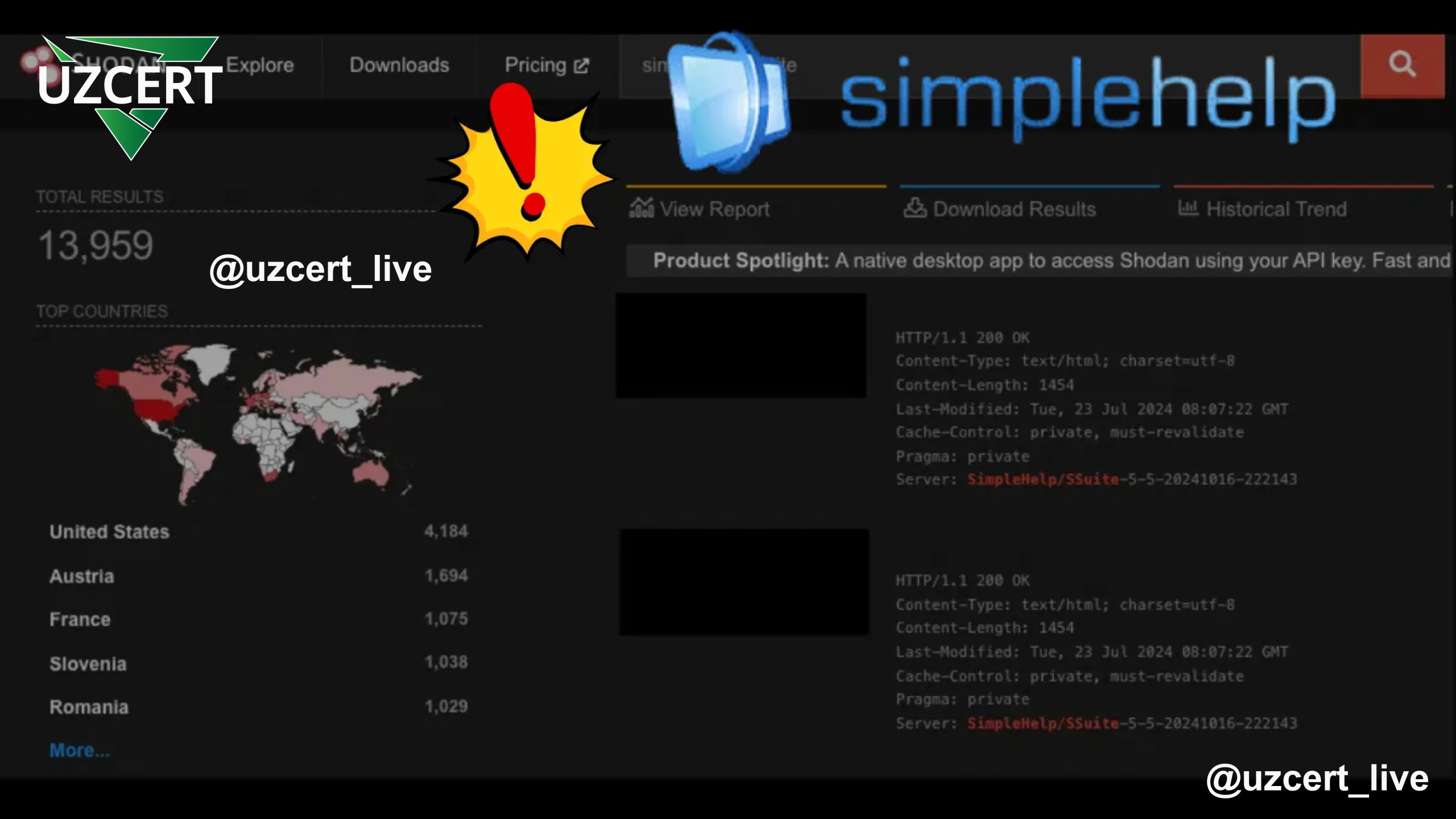
According to security researchers, approximately 14,000 SimpleHelp servers are currently accessible from the Internet, and a portion of them may be vulnerable to this issue.
Vulnerability Overview
The vulnerability was discovered through Horizon3.ai’s AI-powered research initiative known as “Sua Sponte.”
Researchers found that the flaw exists in SimpleHelp’s OpenID Connect (OIDC) authentication implementation, where responses received from the identity provider are not properly validated.
The vulnerability affects deployments where OIDC authentication is enabled and integrated with enterprise identity services, including Microsoft Azure Active Directory.
By exploiting this flaw, an attacker can create a new Technician account and gain access to the system without possessing valid authentication credentials.
One of the most concerning aspects of this vulnerability is that it can also be exploited in environments protected by Multi-Factor Authentication (MFA). During the initial enrollment process, an attacker can register their own authentication method, effectively bypassing MFA protections.
Potential Impact
SimpleHelp is designed to provide remote administration of servers, workstations, and other network-connected devices. If successfully exploited, an attacker could potentially:
- Establish remote access to managed devices;
- Execute commands and scripts;
- Modify system configurations;
- Access sensitive user data;
- Perform lateral movement within the organization’s network;
- Deploy additional malware or backdoor components;
- Gain control over critical information systems.
Because RMM platforms typically operate with elevated administrative privileges, vulnerabilities of this nature can often lead to large-scale cyberattacks, widespread compromise, and significant data breaches.
Scope of Exposure
According to researchers, approximately 3,400 Internet-exposed SimpleHelp servers were identified at the beginning of 2025. By June 2026, that number had increased to nearly 14,000.
Further analysis revealed that approximately 7.2% of those servers are vulnerable to this authentication bypass due to insecure configurations or improper deployment settings.
This suggests that attempts to exploit the vulnerability are likely to increase significantly in the near future.
Indicators of Compromise
System administrators should closely monitor for the following indicators:
- Unknown or unexpected Technician accounts;
- Newly created user accounts associated with unfamiliar email addresses;
- Unauthorized configuration changes;
- Authentication events not initiated by authorized administrators;
- Unexpected execution of scripts or remote commands;
- Suspicious registration or login attempts recorded in system logs.
Researchers specifically recommend reviewing log files stored under:
/opt/SimpleHelp/logs/
for signs of suspicious activity.
Mitigation Recommendations
To reduce the risk associated with this vulnerability, organizations are strongly encouraged to:
- Apply the latest security updates released by the SimpleHelp developers immediately;
- Review OIDC authentication configurations and restrict access to only authorized groups;
- Perform a complete inventory and audit of all existing Technician accounts;
- Enforce the principle of least privilege for administrators and technical personnel;
- Continuously monitor system logs and forward security events to centralized SIEM platforms;
- Restrict access to remote management interfaces using IP-based access controls;
- Protect administrative access through VPN or Zero Trust Network Access (ZTNA) solutions;
- Verify that Multi-Factor Authentication (MFA) is properly configured and review authentication policies;
- Minimize the exposure of Internet-facing RMM services whenever possible.
CVE-2026-48558 serves as another reminder of the critical importance of securing remote management platforms. Because RMM solutions act as centralized administration points for enterprise infrastructure, a single critical vulnerability can place an organization’s entire network at risk.
Organizations using SimpleHelp should prioritize installing the latest security updates, thoroughly review their authentication configurations, and continuously monitor their environments for suspicious activity. Failure to address this vulnerability could allow attackers to exploit a single authentication weakness to compromise an organization’s entire IT infrastructure.