Top 10 GPT Models of 2026 for Cybersecurity Professionals
A New Era for Hackers, Pentesters, and Security Analysts
The rapid development of artificial intelligence technologies is fundamentally transforming the field of cybersecurity. By 2026, specialized models based on GPT (Generative Pre-trained Transformer) have not only accelerated information analysis, but have also taken vulnerability discovery, attack simulation, security mechanism testing, and incident response processes to an entirely new level.
Today, some advanced GPT models are capable of operating as virtual members of Red Teams or Blue Teams. They analyze threats in real time, generate exploitation scenarios, and help improve defensive measures. Below is a detailed overview of the Top 10 GPT tools that are having the greatest impact on cybersecurity practices in 2026.
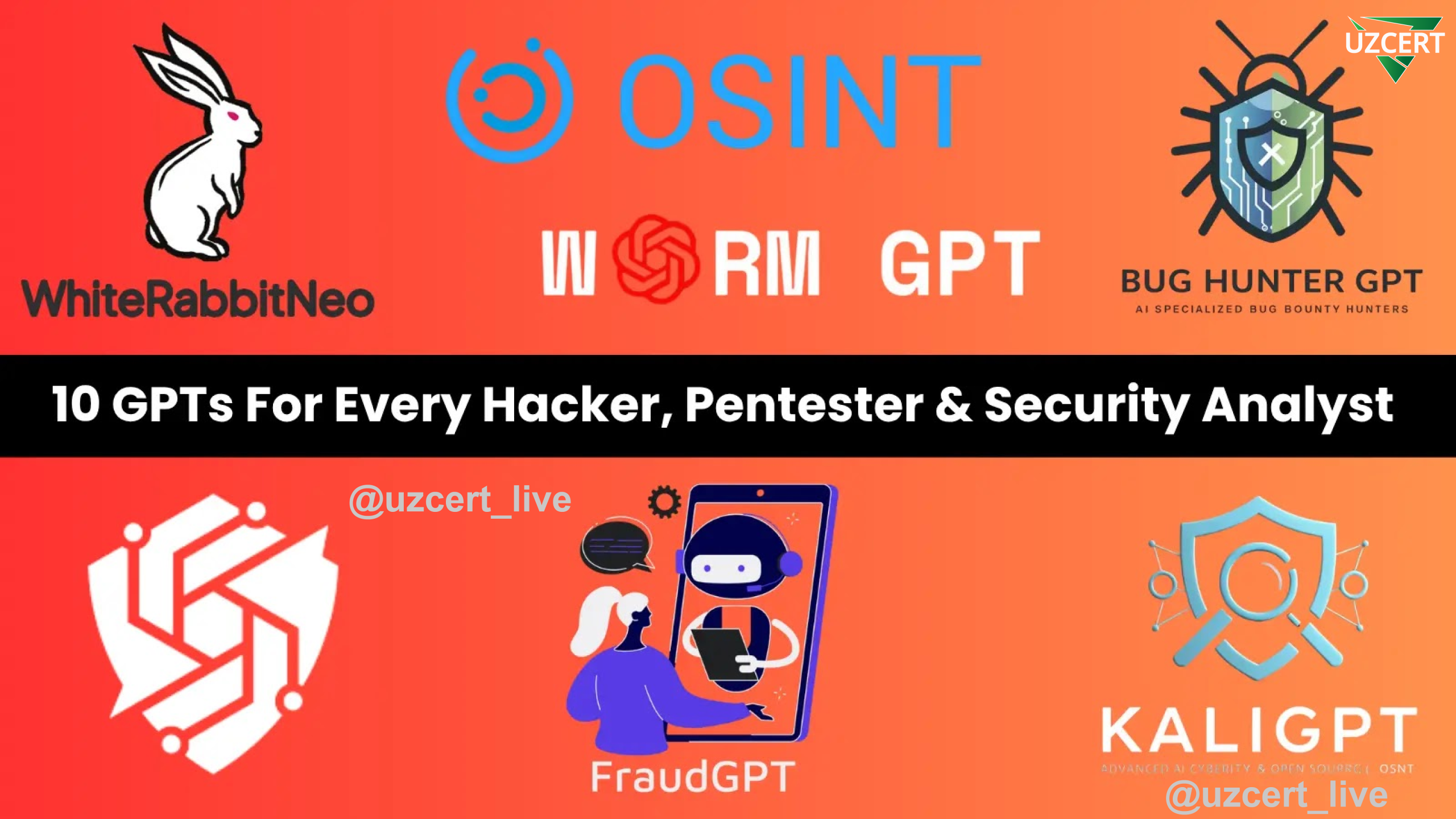
White Rabbit Neo Hacker GPT
Virtual Red Team Specialist
This GPT model is specialized in offensive security analysis and demonstrates high efficiency in identifying vulnerabilities, exploiting them, and writing automated scripts. White Rabbit Neo Hacker GPT integrates seamlessly into DevSecOps processes and automatically generates reconnaissance and exploitation scripts in Bash, Python, and PowerShell. In practice, it resembles a digital counterpart of an experienced pentester.
KaliGPT
An Intelligent Assistant for Kali Linux Users
KaliGPT is designed for professionals working in the popular Kali Linux environment. It explains how to properly use classic tools such as Metasploit, Hydra, and Nmap, interprets command syntax, and guides users through attack phases step by step. It is a convenient assistant for both beginner and experienced pentesters.
OSINT GPT
Automating Open-Source Intelligence
OSINT GPT automates the collection of open-source intelligence (OSINT) by analyzing leaked data, social networks, domains, IP addresses, and WHOIS information. This model plays an important role in footprinting, threat intelligence, and the development of defense scenarios against social engineering attacks.
WormGPT
A Dangerous but Important Tool for Studying Social Engineering
WormGPT is primarily designed to generate phishing, Business Email Compromise (BEC), and social engineering content. It is mainly used within blue team operations and security research to raise employee awareness and test defensive mechanisms. However, due to the serious risks posed by misuse, its application requires strict ethical and legal oversight.
PentestGPT
An Automated Penetration Testing Model
PentestGPT automates scanning, exploitation, and report generation based on international methodologies such as OWASP Top 10. It saves time without sacrificing test depth and is an effective solution for assessing corporate networks and web applications.
FraudGPT
A Laboratory Tool for Fraud Detection Systems
FraudGPT is one of the more controversial tools, used to test fraud detection systems by modeling fraudulent scenarios. It should only be applied in controlled environments and strictly for research and testing purposes.
MalwareDev GPT
For Malware Analysis and Strengthening Defenses
MalwareDev GPT is intended for laboratory-based malware analysis, studying obfuscation techniques, and identifying evasion methods against EDR and antivirus solutions. Its primary goal is to strengthen defenses against malware and support the training of cybersecurity professionals.
Bug Hunter GPT
An Ideal Tool for Bug Bounty and Web Vulnerabilities
Bug Hunter GPT detects common web vulnerabilities such as XSS, SQL Injection, and CSRF, generates proof-of-concept (PoC) exploits, and provides remediation recommendations. It is especially useful for specialists participating in bug bounty programs.
BlueTeam Defender GPT
A Strategic Assistant for Defenders
This model assists with testing SIEM rules, writing YARA and Sigma rules, and developing incident response plans (IR playbooks). It helps align attack and defense scenarios during purple team exercises.
ExploitBuilder GPT
From CVE to Real-World Exploitation
ExploitBuilder GPT specializes in adapting publicly available PoCs into real-world exploits. It offers high accuracy in deep vulnerability analysis and threat modeling and is primarily used in professional penetration testing and security research.
Conclusion: A Balance Between Capability and Responsibility
In 2026, GPT-based tools provide cybersecurity professionals with speed, precision, and deep analytical capabilities. When used within ethical and legal boundaries, they help keep defensive technologies one step ahead of attackers.
However, it is important to remember:
⚠ Technology is neutral — how it is used depends on human responsibility.
Therefore, when using GPT tools, the following principles must be strictly observed:
- adherence to ethical standards,
- compliance with legal requirements,
- operation only within authorized environments.