
CyberSentinel AI Combining 33 Security Tools: Has a New Era Begun for Cybersecurity Professionals?
The rapid development of artificial intelligence technologies in the field of cybersecurity is creating new opportunities for professionals. In recent years, various AI assistants have begun to be used for security analysis, vulnerability detection, and threat assessment, but most of them are limited to providing recommendations. However, the recently unveiled CyberSentinel AI v3.0 platform takes this approach to a new level, fully integrating artificial intelligence with practical cybersecurity tools and delivering tangible results to professionals.
What is CyberSentinel AI?
CyberSentinel AI v3.0 is an open-source cybersecurity platform that combines the capabilities of artificial intelligence with 33 practical security tools. The platform is designed to automate tasks such as security assessments, vulnerability detection, threat analysis, incident response, and compliance evaluation.
The project is published on the GitHub platform, allowing users to deploy it independently within their own infrastructure. One important aspect is that CyberSentinel AI is not dependent on cloud services and can operate entirely offline when necessary.
The Synergy of Artificial Intelligence and Real Security Tools
Many AI assistants can either write commands for the user or recommend which tool to use. CyberSentinel AI goes significantly further. The platform directly executes the following tools and analyzes their results in real time:
- Nmap
- SQLMap
- Nikto
- Nuclei
- OWASP ZAP
- Subfinder
- DNS Recon
- SSL/TLS Analyzer
- WHOIS
- HTTP Header Analyzer
- Ping and Traceroute
For example, when a user requests a security assessment of a specific system, the artificial intelligence analyzes the task, independently selects the necessary tools, performs the checks, and presents the final conclusion in the form of a unified report.
Architecture and Technical Capabilities
The platform runs on Docker Compose and consists of seven containerized services.
Frontend and Backend
The user interface is built on Next.js technology, providing a convenient chat environment for interacting with the AI. The backend is built on FastAPI and performs the following functions:
- analyzing user requests;
- intent classification;
- managing AI models;
- launching security tools;
- aggregating results.
Isolated Kali Linux Environment
All scanning and testing operations are performed in a separate Kali Linux container. This approach ensures the security of the host operating system and reduces the risk of malicious code or incorrectly executed commands affecting the host system.
Agentic AI: An Autonomous Decision-Making Assistant
One of the most important features of CyberSentinel AI is its foundation on an Agentic AI model.
The platform:
- determines the user’s objective;
- selects appropriate tools;
- simultaneously launches up to five tools;
- analyzes the obtained results;
- generates a comprehensive security report.
This significantly reduces the need for manual intervention and increases the efficiency of assessments.
Knowledge Base and Threat Intelligence
CyberSentinel AI utilizes several modern data repositories and analytical systems.
Neo4j
Using the Neo4j graph database, the platform maps relationships between:
- attack surfaces;
- vulnerabilities;
- MITRE ATT&CK techniques.
ChromaDB and RAG
The platform employs Retrieval-Augmented Generation (RAG) technology, which enriches responses based on the following sources:
- MITRE ATT&CK;
- MITRE ATLAS;
- NIST;
- CIS Controls.
As a result, AI responses become more accurate and reliable.
ELK Stack
The SIEM environment based on Elasticsearch and Kibana provides:
- log analysis;
- security incident detection;
- threat hunting based on logs.
Supported Security Tools
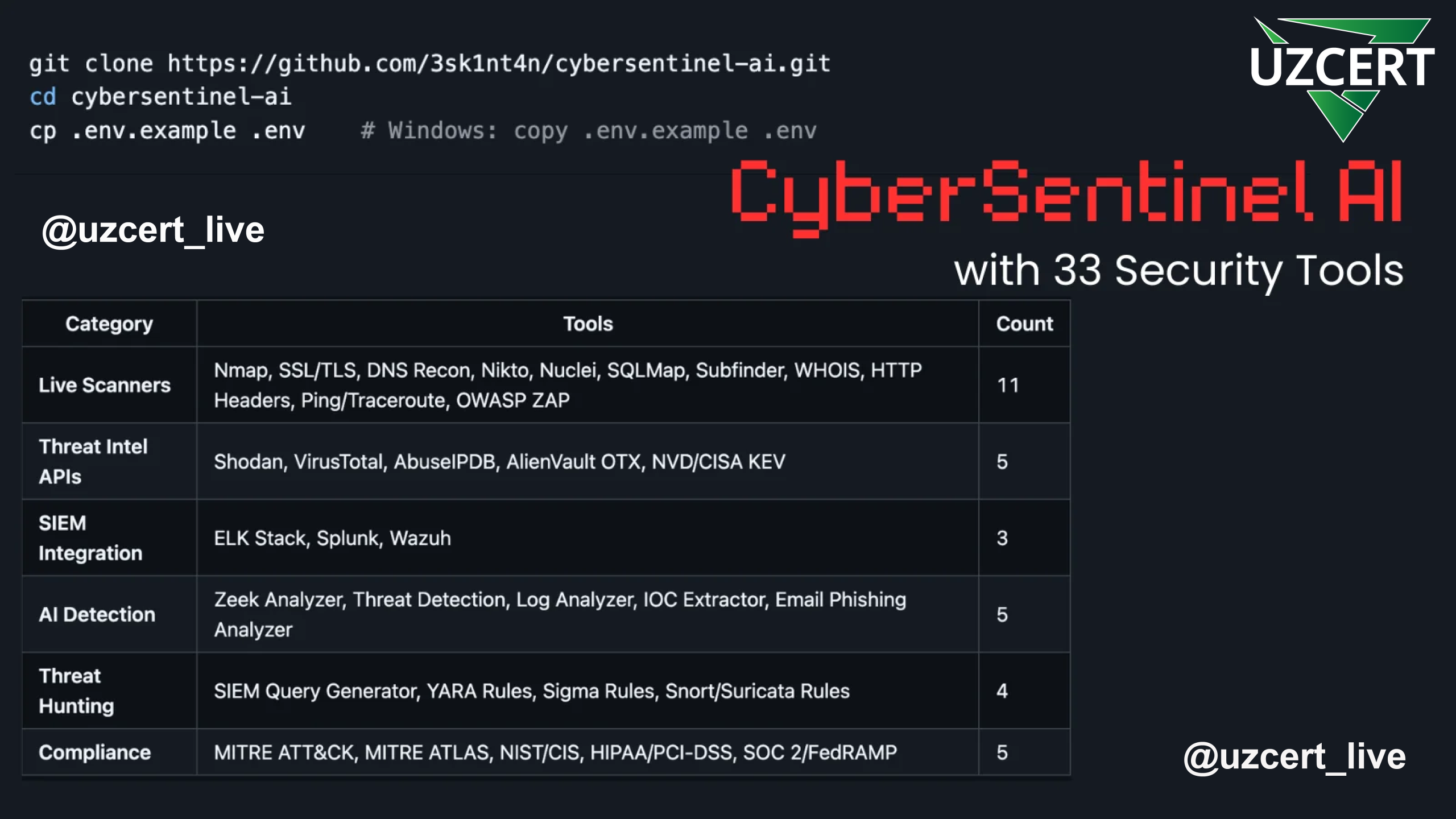
The 33 tools on the platform are divided into six main categories.
1. Active Scanning Tools (11)
- Nmap
- Nikto
- Nuclei
- SQLMap
- OWASP ZAP
- Subfinder
- DNS Recon
- SSL/TLS Analysis
- WHOIS
- HTTP Header Analysis
- Ping/Traceroute
2. Threat Intelligence APIs (5)
- Shodan
- VirusTotal
- AbuseIPDB
- AlienVault OTX
- NVD/CISA KEV
3. SIEM Integration (3)
- ELK Stack
- Splunk
- Wazuh
4. AI-Based Detection Tools (5)
- Zeek Analyzer
- IOC Extractor
- Log Analyzer
- Threat Detection
- Email Phishing Analyzer
5. Threat Hunting Tools (4)
- YARA Rules
- Sigma Rules
- Snort Rules
- SIEM Query Generator
6. Compliance and Audit Tools (5)
- MITRE ATT&CK
- MITRE ATLAS
- NIST/CIS
- HIPAA/PCI-DSS
- SOC 2/FedRAMP
Support for Multiple AI Models
CyberSentinel AI allows users to utilize various artificial intelligence models:
- Claude
- GPT-4o
- over 100 models through OpenRouter
- local models through Ollama
In particular, models such as qwen2.5:7b can be run on a local server. Notably, even when switching models during a conversation, the dialogue context is preserved.
Continuously Updated Threat Data
The platform receives real-time data from the following sources:
- NVD
- CISA KEV
- EPSS
- AlienVault OTX
- Abuse.ch
This enables the retrieval of up-to-date information on newly discovered vulnerabilities and exploits.
Security Mechanisms
CyberSentinel AI incorporates a range of protective mechanisms:
- protection against Prompt Injection attacks;
- blocking of SSRF attacks;
- protection against system prompt disclosure;
- container-level isolation;
- user activity monitoring.
Such mechanisms reduce the risk of attacks directed against the AI system itself.
Practical Significance
CyberSentinel AI can be particularly useful for the following professionals:
- penetration testers;
- Red Team specialists;
- SOC analysts;
- Threat Hunters;
- information security auditors;
- students and researchers studying cybersecurity.
The platform enables centralized execution of vulnerability scanning, threat analysis, log review, and compliance assessment.
CyberSentinel AI v3.0 is one of the promising platforms created through the synthesis of artificial intelligence and practical cybersecurity tools. It possesses the capability not only to launch security tools but also to deeply analyze their results and present users with comprehensible conclusions.
The Agentic AI concept, offline operation capability, integration of numerous security tools, and enrichment with modern threat intelligence sources make CyberSentinel AI a promising solution for cybersecurity professionals. This project is regarded as a significant step toward automating and accelerating security operations with the help of artificial intelligence in the future.