
Critical Vulnerability in Fortinet FortiSandbox Allows Unauthorized Remote Command Execution!
Dangerous Vulnerability Discovered in the FortiSandbox Platform
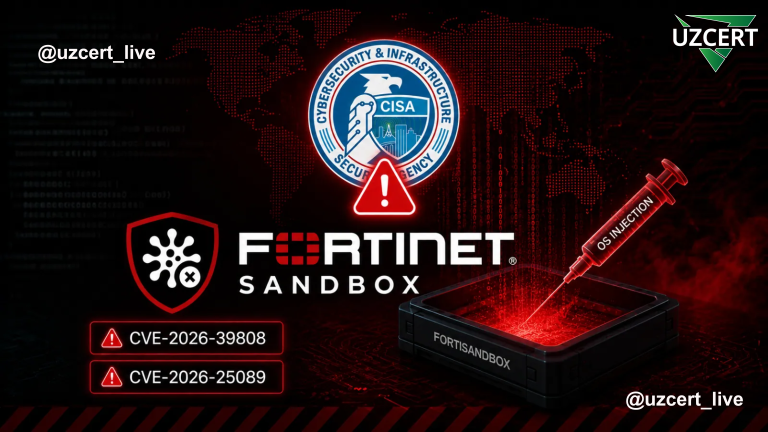
As an important warning for information security professionals, Fortinet has announced the discovery of a high-severity security vulnerability affecting its FortiSandbox product line. The vulnerability, tracked as CVE-2026-25089, allows remote and unauthenticated execution of operating system commands.
The vulnerability has been assigned a CVSS v3 score of 9.1, placing it in the Critical severity category. The primary risk lies in the fact that exploitation does not require a valid user account or administrative privileges. By sending specially crafted HTTP requests, an attacker can execute arbitrary commands on a vulnerable system.
Technical Description of the Vulnerability
According to security researchers, the vulnerability originates from improper handling of operating system commands within the FortiSandbox web management interface. The issue has been classified as a CWE-78 OS Command Injection vulnerability.
Command Injection vulnerabilities allow attackers to inject malicious code into system commands executed by an application. As a result, an attacker may be able to:
- Execute arbitrary operating system commands;
- Modify server configurations;
- Access sensitive information;
- Install malicious software;
- Disrupt system services;
- Conduct further attacks across the corporate network.
The most dangerous aspect of this vulnerability is that the attack does not require authentication. This makes Internet-accessible FortiSandbox systems particularly attractive targets for cybercriminals.
Why Is This Vulnerability Dangerous?
FortiSandbox is widely used by organizations and enterprises to analyze malware, inspect unknown files, and detect advanced threats. The platform is often a critical component of an organization’s cybersecurity infrastructure.
If an attacker successfully compromises a FortiSandbox server, they may be able to:
- Bypass malware detection mechanisms;
- Manipulate security monitoring systems;
- Establish a foothold for accessing other systems within the network;
- Conceal or falsify security-related events.
For this reason, the vulnerability should not be viewed merely as a typical web application flaw, but rather as a serious threat to an organization’s entire security infrastructure.
Affected Products
According to Fortinet, the following products and versions are affected by the vulnerability:
FortiSandbox
- Versions 5.0.0 – 5.0.5;
- Versions 4.4.0 – 4.4.8.
FortiSandbox Cloud
- Versions 5.0.4 – 5.0.5.
FortiSandbox PaaS
- Versions 5.0.4 – 5.0.5.
Unaffected Versions
The following products have been confirmed as not affected by this vulnerability:
- FortiSandbox 5.2;
- FortiSandbox Cloud 4.4;
- FortiSandbox Cloud 5.2;
- FortiSandbox PaaS 4.4;
- FortiSandbox PaaS 5.2;
- FortiSandbox PaaS 23.4.
Vendor-Provided Fixes
Fortinet has released security updates to address this vulnerability and has advised customers to upgrade to the following versions as soon as possible:
| Product | Recommended Version |
|---|---|
| FortiSandbox 5.0.x | 5.0.6 or later |
| FortiSandbox 4.4.x | 4.4.9 or later |
| FortiSandbox Cloud | 5.0.6 or later |
| FortiSandbox PaaS | 5.0.6 or later |
The vulnerability was discovered by Adham El Karn of Fortinet’s Product Security Incident Response Team (PSIRT) and published under advisory reference FG-IR-26-141.
Exploitation Status
At present, there are no confirmed reports of this vulnerability being exploited in real-world attacks. However, experience has shown that critical vulnerabilities requiring no authentication are often targeted shortly after public disclosure, and exploit tools can be developed within a short period of time.
This is especially true for Internet-facing security appliances and analysis platforms, which are routinely identified by attackers through automated scanning tools.
Recommendations for Organizations
To reduce the risk posed by this vulnerability, organizations are advised to implement the following measures:
Update the Software Immediately
All affected FortiSandbox systems should be upgraded to the versions recommended by the vendor as quickly as possible.
Restrict Access to the Web Interface
Until updates have been fully deployed, access to the FortiSandbox Web UI should be restricted to trusted IP addresses or dedicated management network segments.
Analyze Security Logs
Organizations should regularly review logs for unusual HTTP requests directed at the web interface, requests targeting unknown URLs, and indications of suspicious command execution.
Strengthen Network Monitoring
Continuous monitoring should be performed to detect unusual outbound connections to external servers, unauthorized file uploads, and the creation of new user accounts.
Enhance Network Segmentation
FortiSandbox servers should be isolated from other critical information systems through appropriate network segmentation controls.
CVE-2026-25089 is one of the most serious vulnerabilities discovered in Fortinet FortiSandbox products, as it enables unauthenticated remote command execution. The low attack complexity, absence of authentication requirements, and impact on a central component of an organization’s security infrastructure make this vulnerability particularly dangerous.
Therefore, all organizations using FortiSandbox are strongly advised to apply security updates immediately, restrict access to web management interfaces, regularly analyze security logs, and strengthen existing protective measures. Timely implementation of these preventive actions will help prevent potential cyberattacks and ensure the reliable protection of organizational information assets.